
A New Dawn for Public Service: NIEPA Ondo Transitions to Objective Performance Management System
Reported by Bodunde Tenabe
ONDO CITY — In a decisive move to institutionalize accountability and elevate service delivery, the National Institute for Educational Planning and Administration (NIEPA-Nigeria) has officially commenced the implementation of the Federal Government’s new Performance Management System (PMS). The transition was launched during a high-level, two-day capacity-building workshop for Heads of Departments and Units, held from 1st to 2nd July 2026, at the Institute’s Computer Laboratory in Ondo.
Developed in response to a recent Federal Ministry of Education (FME) directive in Abuja, the workshop serves as NIEPA’s strategic platform to officially designate its own departmental and unit heads as the frontline “Champions” driving the new policy implementation across the Institute.



Setting the stage for the institutional overhaul, the Registrar of the Institute, Dr. Festus Olaolu, delivered a compelling welcome address, declaring the introduction of the PMS a “new dawn in the history of the Nigeria Public Service”. He announced the definitive retirement of the Annual Performance Evaluation Report (APER)—an appraisal method rooted in the 1976 Udoji Commission, which he characterized as highly subjective, defective, and no longer aligned with the Federal Government’s result-oriented priorities.
Dr. Olaolu charged the gathered administrative leaders to immediately key into the new vision, appealing for their full cooperation to ensure seamless implementation. He directed all Heads of Departments to draft clear departmental action plans, assign precise individual job descriptions, and establish active mentoring processes to achieve set goals.
“Performance Management System is driven by objective assessment and interaction between the Supervisor and Supervisee,” the Registrar explained.
Under this new framework, both parties will agree on specific tasks within a set timeframe, bound together by a signed Annual Performance Contract. This agreement serves as the baseline for continuous monthly assessments, quarterly reviews, and ultimately, the yearly performance approval.
Delivering the formal Opening Address, the Director-General and Chief Executive of NIEPA, Dr. David Shofoyeke, seized the moment to deliver his inaugural address to the staff as the substantive Director-General. In a comprehensive, fatherly, and forward-looking 45-minute address, Dr. Shofoyeke prioritized staff welfare and institutional unity. He compassionately admonished the workforce to remain focused on the Institute’s core mandate, encouraging them to foster a positive workplace culture and avoid the distractions of unverified information. Reassuring the staff of his unwavering commitment to their career progression, the Director-General confirmed that management is working proactively to ensure the prompt release of promotion letters for deserving personnel.
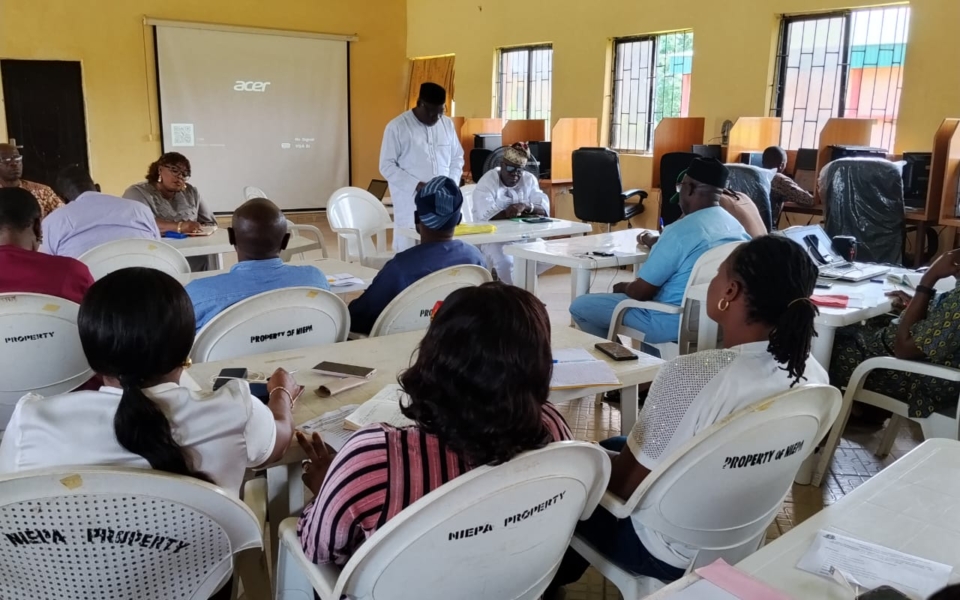


Having galvanized the team with this message of reassurance and solidarity, Dr. Shofoyeke pivoted to the core theme of the day. He expanded on the Registrar’s remarks, describing the new PMS not as a bureaucratic hurdle, but as a transparent, empowering tool designed to objectively recognize and reward hard work. He charged the newly designated “Champions” to fully embrace the result-oriented appraisal framework as a critical catalyst for driving both personal career growth and broader institutional excellence.
Following the Director-General’s address, the technical and philosophical parameters of the system were laid bare by Dr. Festus Olaolu and Dr. Nojeem Oresajo. Delivering an analytical presentation on the Institute’s deliverables and their alignment with PMS, they detailed the evolution of the public service from colonial-era bureaucracy and the ineffective APER system to this modern, result-oriented framework. They stressed that the overarching objective of this reform is to transform the machinery of government into an efficient, effective, and productive tool for national development.



The event then transitioned into a robust and candid interactive forum. Staff members engaged deeply with the practical realities of the transition, ensuring the dialogue remained grounded in administrative reality rather than mere theory. Dr. Samson Oyeromi raised critical questions regarding the intersection of the PMS with existing promotional examinations, specifically seeking clarity on the percentage weight the new appraisal system would carry for career advancement.
Furthermore, participants including Mr. Bola Adejori and Engr. Williams Egbele brought vital structural challenges to the fore. They questioned how “Champions” and their subordinates could be fairly and objectively evaluated in instances where the enabling environment, operational funding, and necessary working tools were constrained.
Both presenters, along with the Institute Bursar, Mrs. Lolade Shittu, addressed these operational anxieties by clarifying the core tenets of the new system. They emphasized that PMS demands a fundamental shift in organizational culture, focusing heavily on clear target-setting, transparency, and the strategic tracking of progress across national, ministerial, and departmental levels, ensuring that performance is measured by concrete results rather than mere activities.
The epoch-making workshop, which successfully laid the groundwork for a more transparent and performance-driven institutional culture, was officially brought to a close with remarks from the Institute’s Bursar, Mrs. Lolade Shittu.